The pod brings its own room. The building still has to receive it.
A health screening pod arrives with walls, air conditioning, a floor, a door and the kiosk already inside it - which is exactly why the questions that hold up an installation are never about the pod. They are about your bay, your circuit, your lift, and the person who unlocks it on a Monday morning.
This page is that list. Written by Clinics On Cloud, who build the pod at Chakan - and who would rather you ask these before delivery than discover them with a lorry outside.
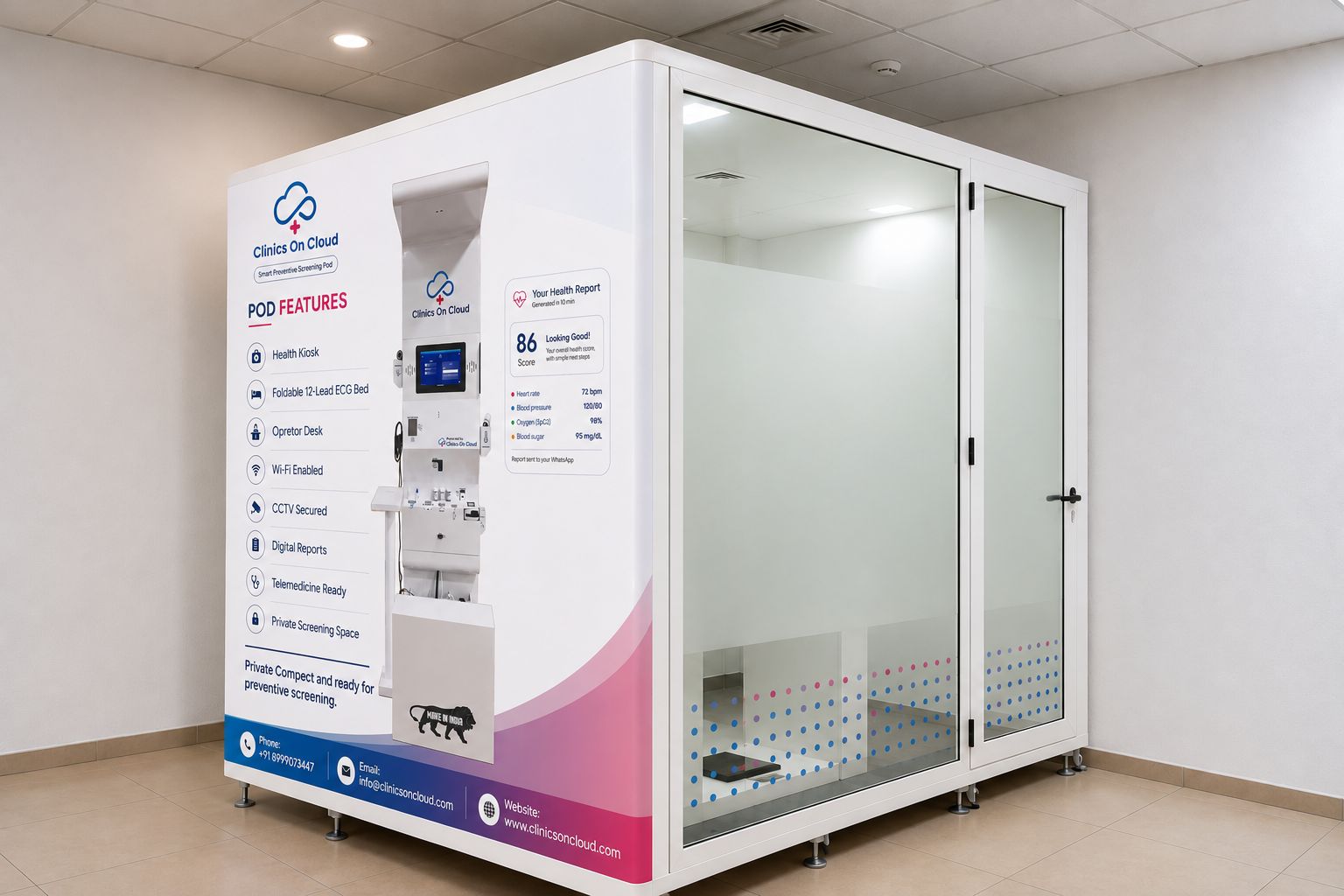
A pod is a room that comes with its own walls.
Worth listing first, because half of what a facilities team starts pricing is already inside the shell. All of this is Clinics On Cloud's published specification for the Health Lounge, quoted rather than estimated here.
Clinics On Cloud call these indicative highlights and offer the full specification sheet on request. Ask for it before you plan the bay: the sentences below are the ones the sheet has to answer for your building in particular.
It installs in a lobby. Which lobby is your decision.
The published line is that the pod installs in standard atrium and lobby bays, indoors or out. That is a real answer, and it is also the point at which the building takes over.
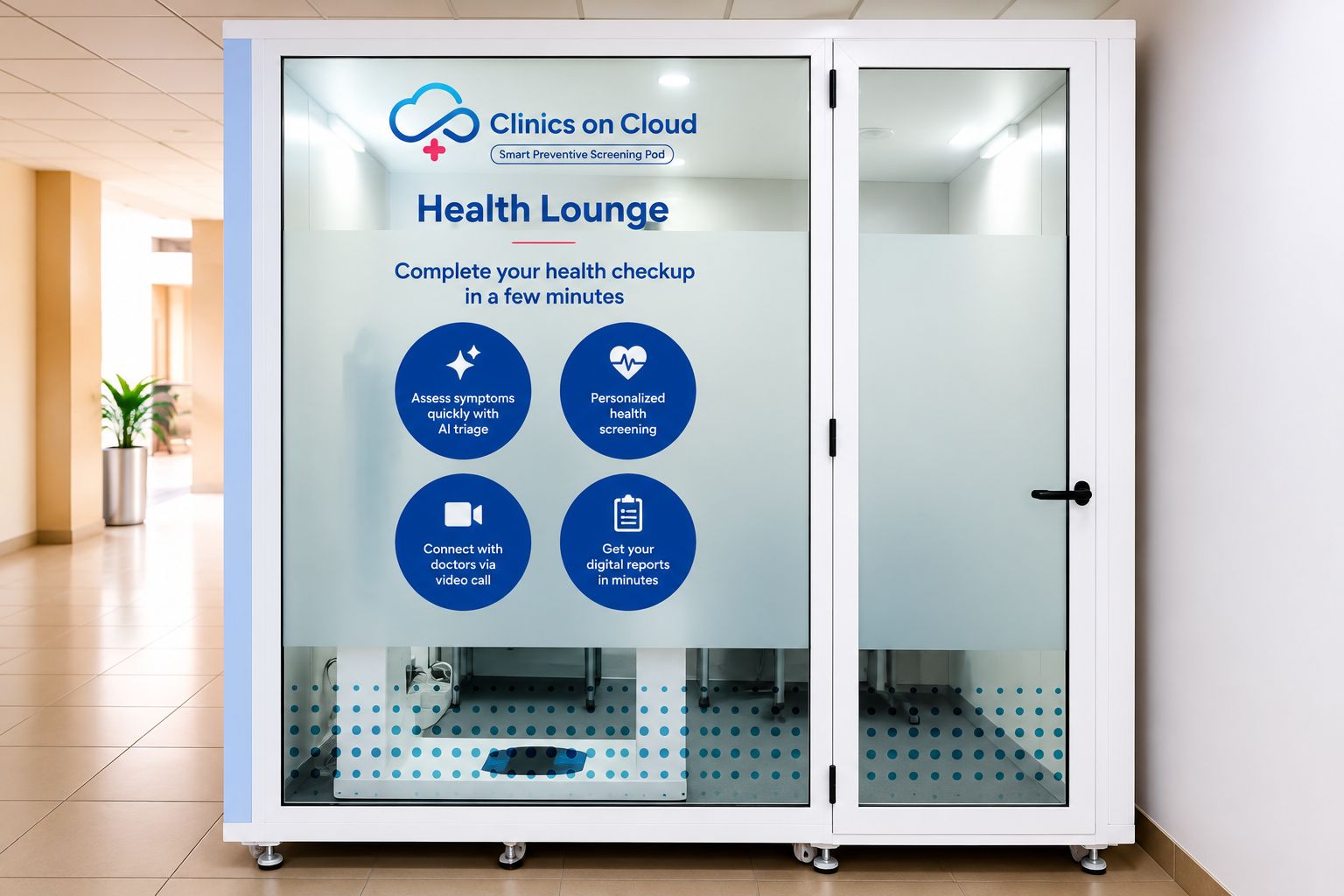
- Footprint
- Compact pod, approx. 50 sq ft; indoor and outdoor shells
- Shell
- Heavy-duty steel with frosted glass panels, sound-softened for privacy
- Interior
- Air-conditioned, FRP-lined walls, carpeted flooring
- Power
- Standard AC supply; battery backup option for events
- Connectivity
- 4G or Wi-Fi, cloud-synced records and telemedicine
- Screening
- 65+ indicators across 14 specialities, visit about 10 minutes
- Reports
- Thermal print on the spot, plus WhatsApp and email
- Indicative cost
- ₹15-20 lakh, by customisation and configuration
Two words in that table do the most work. Standard AC supply tells you the pod does not need a plant room; it does not tell you which circuit, how much load, or who runs the point - and a socket shared with the lobby's cleaning equipment is a socket that gets unplugged. Compact tells you the footprint, not the route it takes to reach the bay.
Five steps, and the building fails at step two.
Not the pod's sequence - yours. Each step is somebody in your organisation, named before the lorry is booked rather than on the morning it arrives.
Survey the bay
Somebody stands in the spot with a tape. Floor level, clearance above, what the doors open into, and where the nearest power point and network point actually are - not where the drawing says they are.
Walk the route in
From the loading bay to the bay itself: door widths, lift car size, turning space, thresholds. Ask the manufacturer whether the shell arrives assembled or in panels, because that single answer decides whether the route works.
Position and level
The pod stands on adjustable feet. A finished floor that looks flat rarely is, and a door that will not close on the first day is remembered for a year.
Power and network
Its own point, on a circuit nobody else is sharing. Decide whether it runs on your Wi-Fi or on its own mobile data, and who owns that connection when it stops working on a Sunday.
Open with a person in it
The first week decides whether people use it. A pod that is opened quietly and left to be discovered gets discovered by almost nobody.
Four jobs, and three of them belong to you.
Clinics On Cloud train the operator and provide installation and after-sales support. The rest is named in your organisation or it is named by nobody.
The host
Facilities or admin: unlocks it, keeps the bay clear, and is the person a visitor asks when the door will not open.
The operator
Trained on the workflow and on helping first-timers. The published design is voice-guided and multilingual, which lowers the bar - it does not remove the person.
The stock owner
Strips, lancets, printer paper, cleaning materials. One name, counted per week of use rather than per financial year.
The follow-up
Whoever calls the person whose reading came back flagged. Without this the pod is a machine that prints worry.
The tests are the same. The enclosure is the choice.
This is the comparison worth making before the bay is planned, and Clinics On Cloud answer it plainly enough that it can be quoted rather than paraphrased.
Read the gap between those two figures as what a room costs. If your site already has a private room with power and a door, a kiosk in it does the same clinical work. If it does not - and most lobbies, atria and factory floors do not - the pod is the room.
Nine questions nobody publishes answers to.
Not criticism of any manufacturer. These depend on your building and your organisation, which is why no specification sheet can answer them - and why they belong on your list, in writing, before delivery.
What load, on whose circuit?
"Standard AC supply" is the published answer. Get the actual rating, and get the pod its own point rather than a shared socket.
Does the route in exist?
Assembled or in panels; door widths, lift car, turning space. The commonest reason a pod sits in a car park for a week.
Will the floor take it?
A steel shell on levelling feet is a point load. Above ground level, that is a question for whoever holds the structural drawings.
Whose network, whose SIM?
4G or the venue's Wi-Fi, and who is called when it drops. Reports and teleconsultation both live on this answer.
Who is the operator, on paper?
Your employee, an agency's, or the site's? Trained by whom, replaced by whom, and covered during leave.
Who reorders consumables?
Strips and lancets have a shelf life and a lead time. Name the person and the trigger quantity, not the department.
Waste, under whose licence?
Lancets and test strips are biomedical waste. Somebody's licence covers their disposal; establish whose before the first visitor.
Whose doctor takes the call?
Clinics On Cloud do not publish whose doctors staff a teleconsultation, and accountability for the advice follows that answer. Settle it in the contract rather than in the first difficult case.
Who acts on a flagged reading?
Within how long, and with what they can offer. A screening programme is judged on this and on nothing else.
Built in India, at a CDSCO-registered and ISO 13485-certified facility






Questions, answered.
Answered by the team at Clinics On Cloud, and kept in step with what they publish - these are pulled from the portal each time this page is built.
What is Health Lounge?
Health Lounge is a technology-enabled dedicated healthcare and wellness space- equiped with digital health technology for preventive screening, wellness services, telemedicine and digial healthcare support. It combines a Health Kiosk or Health ATM with a comfortable, dedicated setup where users can check vital parameters, receive digital health reports, track health records and connect with doctors through teleconsultation. It can be installed in residential societies, corporate offices, hospitals, pharmacies, institutions and community spaces. The Health Lounge works like a smart microclinic, making regular health monitoring, early risk identification and preventive care more convenient, accessible and connected without requiring patients to visit a hospital for every basic health check.
Where can a Health Lounge be deployed?
A Health Lounge can be deployed across multiple environments depending on the healthcare use case: * CSR Projects: To create a dedicated community healthcare access point for preventive screening, telemedicine, digital health records and ongoing wellness programs. * Hospitals & Clinics: To extend preventive healthcare beyond the consultation room and offer convenient screening, diagnostics and follow-up services. * Factories & Corporates: To provide employees with regular health screening, workplace wellness programs and early identification of potential health risks. * Residential Communities: To give residents convenient access to preventive health checks, wellness monitoring and doctor consultations within their society or community.
What is the difference between a Health Lounge and a Health Kiosk?
A Health Lounge is a private, dedicated healthcare space that combines preventive screening, telemedicine and digital health services in a more comfortable setup. It can include an operator area, consumable storage, AC and connectivity provisions, private doctor consultation space, and a convertible patient bed for examinations such as ECG.
How much does it cost to set up a Health Lounge?
A Health Lounge typically costs between ₹15 lakh and ₹20 lakh, depending on the level of customization, medical equipment, number of health tests, interiors, telemedicine setup, software and other infrastructure requirements.
Healthcare is a right. Not a privilege.
We started Clinics on Cloud with a simple belief - that the quality of your healthcare should not depend on your postcode. Whether you’re a government, corporate, NGO or entrepreneur - we built this for you.
+91 8999 073 447
Mon - Sat · 9 AM to 6 PM IST
sales@clinicsoncloud.com
Partnerships · Deployments · Support
www.clinicsoncloud.com
Products · Case Studies · News
Nighoje, Chakan MIDC
Pune, Maharashtra - 410501, India